
Saint-Malo
"I have never watched the sea disappear and reappear twice in one afternoon anywhere else."
A walled corsair city on Brittany's Emerald Coast where the tide swings nearly fourteen metres and the ramparts turn the whole town into a stage for watching the sea come and go.
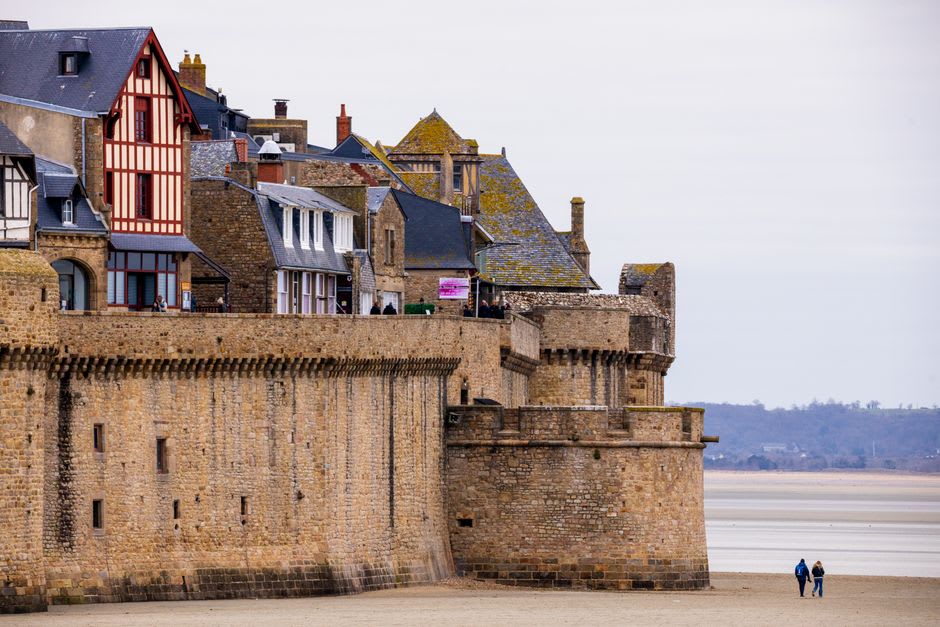
Lia grew up nowhere near an ocean, and the first time we stood on Saint-Malo’s ramparts and watched the tide go out — really out, exposing half a kilometre of rippled sand where fishing boats had been bobbing three hours earlier — she made me promise we’d come back and see it flood in again before dinner. We did. Saint-Malo does that to people. The Atlantic here has one of the biggest tidal ranges in the world, and the whole town, walls and all, is built to be watched from above while the water performs.
A city that was rebuilt stone by stone
What you’re walking through inside the walls, the Intra-Muros, looks medieval and mostly isn’t — the old city was flattened in August 1944 during the Allied push to retake the port, and the Malouins spent the better part of two decades rebuilding it using the original stone and old photographs, arguing the whole time about how faithful to be. You’d never know it from the granite streets around Rue Jacques Cartier, named for the local sailor who claimed Canada for France, or from the Cathédrale Saint-Vincent with its stained glass replaced in bold modern colour after the originals were destroyed. We climbed the chemin de ronde, the rampart walkway that circles the entire old town, at sunset and did the full loop twice, once for the view of the walled city’s slate roofs and once for the tide coming in over the sand below.
Corsairs, oysters, and a walk to Fort National
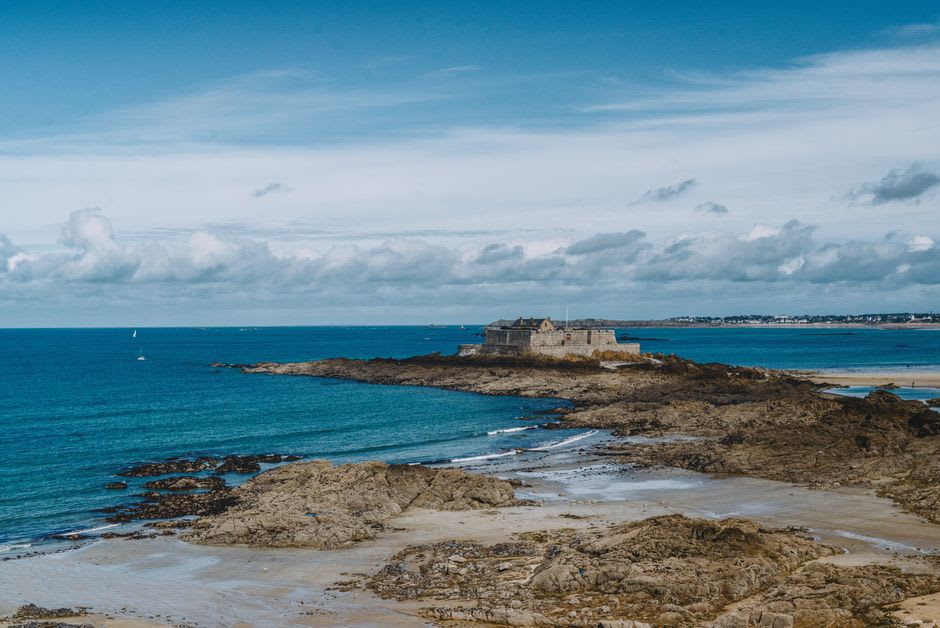
Saint-Malo made its fortune on corsairs — privateers licensed by the French crown to raid English and Dutch shipping, which is a polite way of saying state-sanctioned piracy, and the city still names streets after its most successful ones. At low tide you can walk out across the sand to Fort National, a squat 17th-century fortress built by Vauban that sits stranded in the bay for half the day and cut off by sea for the other half; we timed it badly once and had to wait forty minutes on the fort’s steps for the water to drop enough to walk back. Afterward we went looking for oysters and ended up in Cancale, a short drive east, sitting on the harbour wall eating them straight from the shell for a couple of euros a dozen while the ostréiculteurs worked the beds visible from where we sat.
When to go: Aim for a period with a big tidal coefficient, which the local tourism office publishes daily, so you actually get the dramatic swing between full bay and bare sand. Late spring and early autumn give you mild weather and a town that hasn’t filled up with the full French summer crowd.