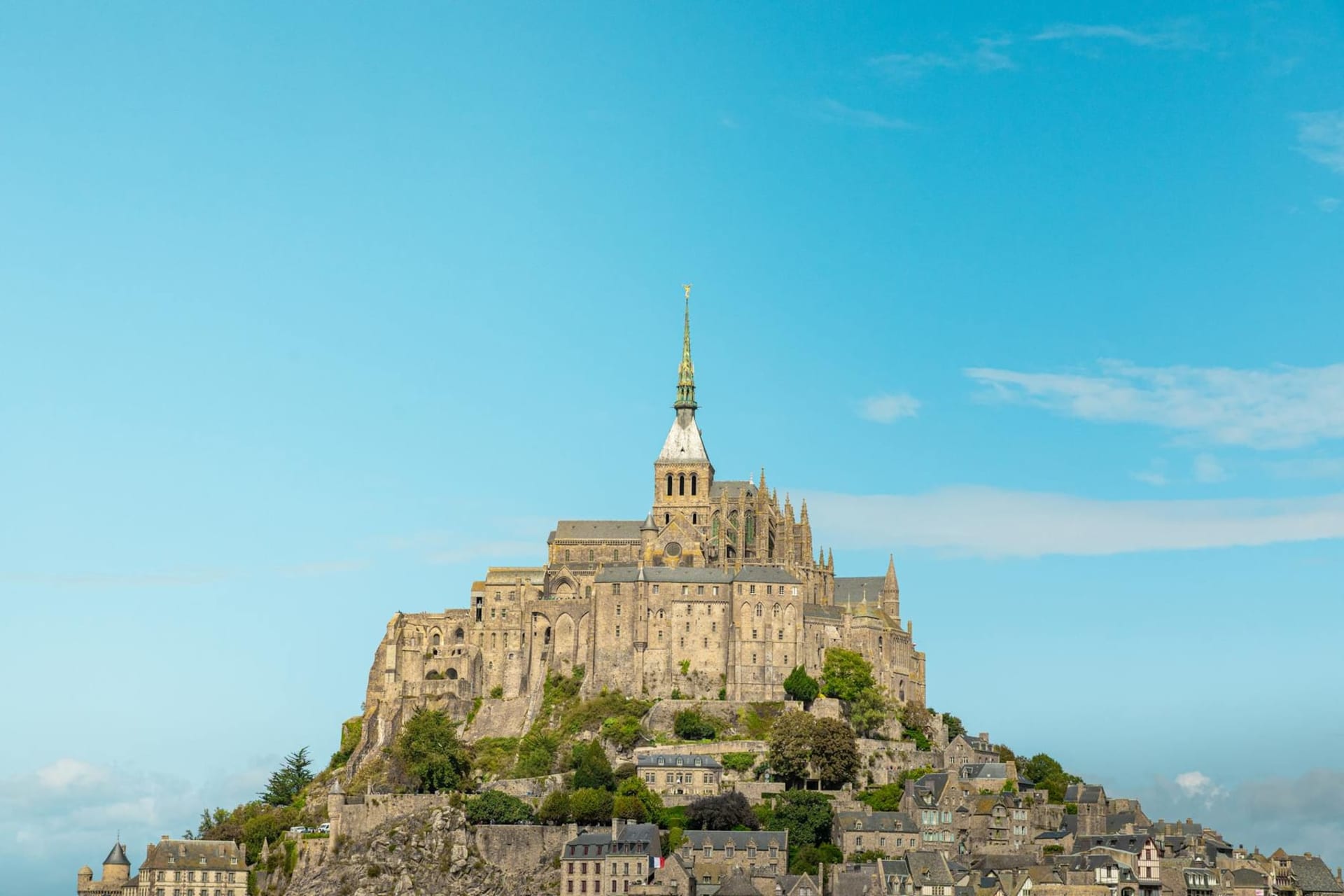
Mont Saint-Michel
"Mont Saint-Michel looks like God planted an idea in the sea and watched it grow."
I saw Mont Saint-Michel for the first time from the D275, twenty minutes out, and I pulled over without thinking. Not because the road was narrow or the light was changing — though both were true — but because the island appeared in the windshield like something my brain couldn’t immediately file. A needle of granite and medieval ambition jutting from a perfectly flat sea of sand. I sat there for a moment with the engine running, not saying anything. Lia put her hand on the dashboard as if to steady herself.
The Island Before the Crowd
We arrived on a Tuesday in late October, which is the only reason I can write about this place with any affection. By nine in the morning the Grande Rue — the single cobbled artery that spirals up through the village toward the abbey — was already filling with groups following color-coded flags, but an hour earlier it had been ours. The smell at that hour is salt and cold stone and something faintly animal, probably the sheep that graze the surrounding polder. Norman pre-salé lamb. I’d read about it before coming; the meat absorbs the salt of the bay grass and tastes unlike any lamb I’ve had anywhere else. We found a small place near the Porte du Roi that served it simply, with cider, and it was one of those meals that requires no conversation.
The Abbey at the Top
The Abbaye du Mont-Saint-Michel is not subtle. It announces itself at every turn of the staircase, each new courtyard opening onto a view more vertiginous than the last. What surprised me — genuinely surprised me, in a way the photographs had not prepared me for — was the cloister. I’d expected grandeur. What I found instead was this narrow gallery of paired columns, impossibly delicate, seemingly too thin to hold anything up, with a garden planted in the center that was just grass and silence. After the battering scale of the nave, the cloister felt like an exhale. I stood there longer than I meant to.
The bay from the ramparts changes every twenty minutes. The tides at Mont Saint-Michel are among the fastest-rising in Europe — locals still say the sea comes in at the speed of a galloping horse — and watching the water find its channels across the sand is genuinely unsettling in the best way. Ancient, indifferent, completely unmoved by the fact that we’ve built a UNESCO site on top of it.
Coming and Going
The crossing via the submersible road — or the long boardwalk when the road floods — is part of the experience. Don’t rush it in either direction.
When to go: Late September through early November for smaller crowds, dramatic autumn light, and the best chance of catching the grandes marées — the high tidal coefficients that bring the water right to the walls. Avoid July and August unless you enjoy queuing on medieval staircases.