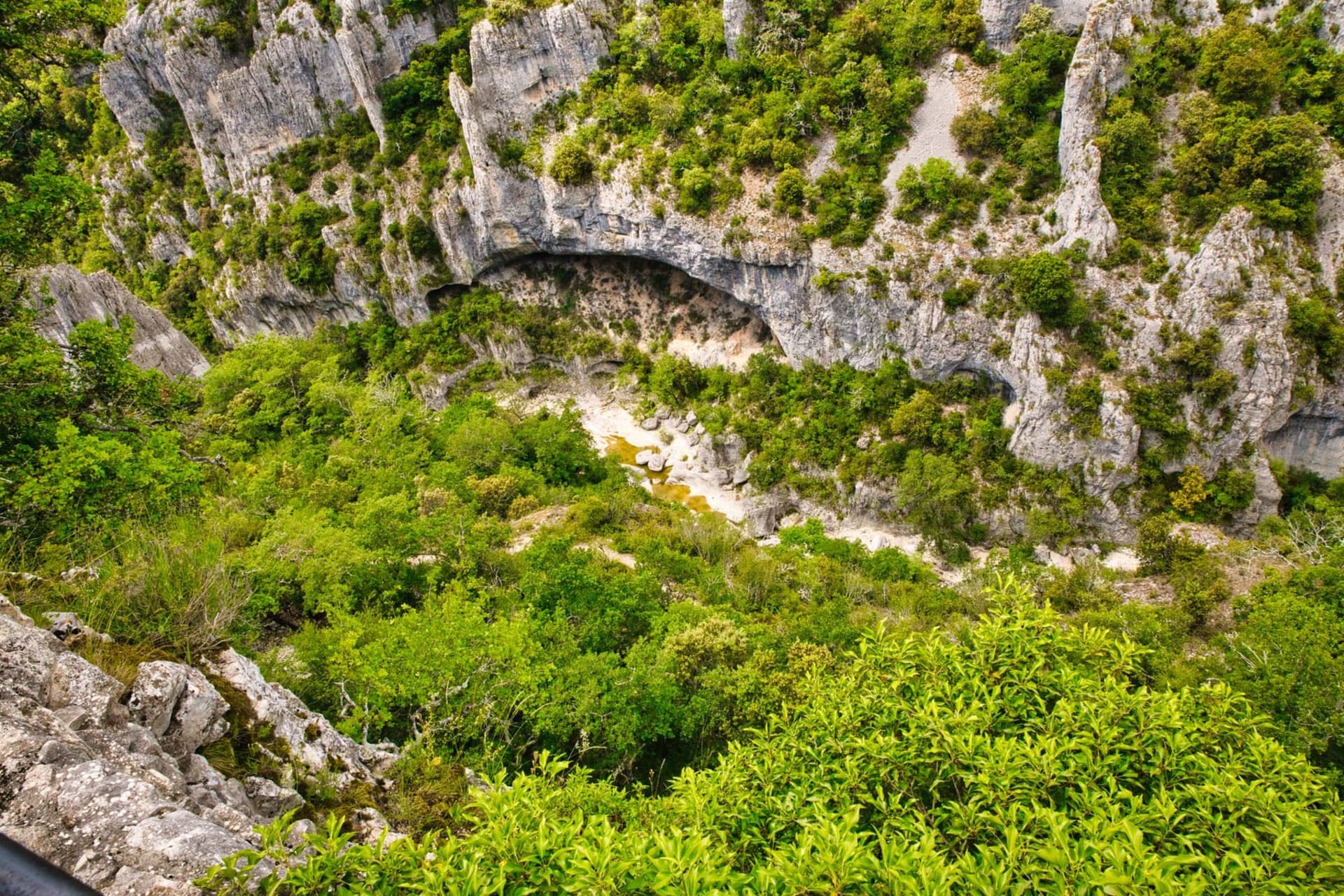
The road from Olonzac drops without warning into the garrigue, and then the gorge opens. I pulled over before the descent because the view stopped making sense — there was a village in the middle of the air, perched on a spur of limestone above two dry riverbeds, and the only way in was a single narrow bridge barely wider than my shoulders. Minerve does not announce itself. It simply appears, already ancient, already indifferent to whether you find it or not.
The Bridge and the Last Alley
The Pont des Buis brings you across the gorge of the Cesse in twenty steps, and then the village swallows you. There are perhaps two dozen inhabited houses and a single street, the Grand Rue, which takes five minutes to walk end to end if you stop for nothing — which is impossible. The smell of wild thyme comes off the walls. A cat sleeps on the stone steps of what may once have been a commandery. At the far end, a tower from the twelfth century stands above the gorge of the Brian, and from there, on a clear morning, the shadow of the spur falls like a blade into the pale limestone below.
Lia found the natural tunnels before I did. The Cesse, which runs underground for much of the year, has carved two arched passages through the rock — the Grand Pont and the Petit Pont — and we climbed down to walk through them, our voices going strange in the hollow stone. I had not known to expect this. The village brochure mentioned a Cathar memorial and the church; it said nothing about standing inside a mountain while a dry river breathed around you.
Cathar Walls and a Table at the Relais
Minerve fell to Simon de Montfort in 1210. There is a small museum on the Grand Rue — the Musée Hurepel — where the Cathar siege is told in miniatures, and it is better than it sounds. Outside the museum, a reproduction trebuchet called La Malvoisine occupies a terrace above the gorge, and in the afternoon light it casts a long, absurd shadow. I ate a plate of local charcuterie at the Relais Chantovent — cured ham from the Montagne Noire, a rough terrine, bread that was not warm but was honest — and drank a glass of Minervois rouge that tasted like the limestone itself, dry and mineral and just slightly too warm.
The gorge keeps it secret from the rest of Languedoc. Most of the Hérault passes it by. That is, as far as I can tell, the entire point.
When to go: Late April through early June, before the summer heat bakes the limestone and the day-trippers arrive from Carcassonne. September is also quiet and golden, and the Minervois harvest brings a particular smell of must into the air around the village.