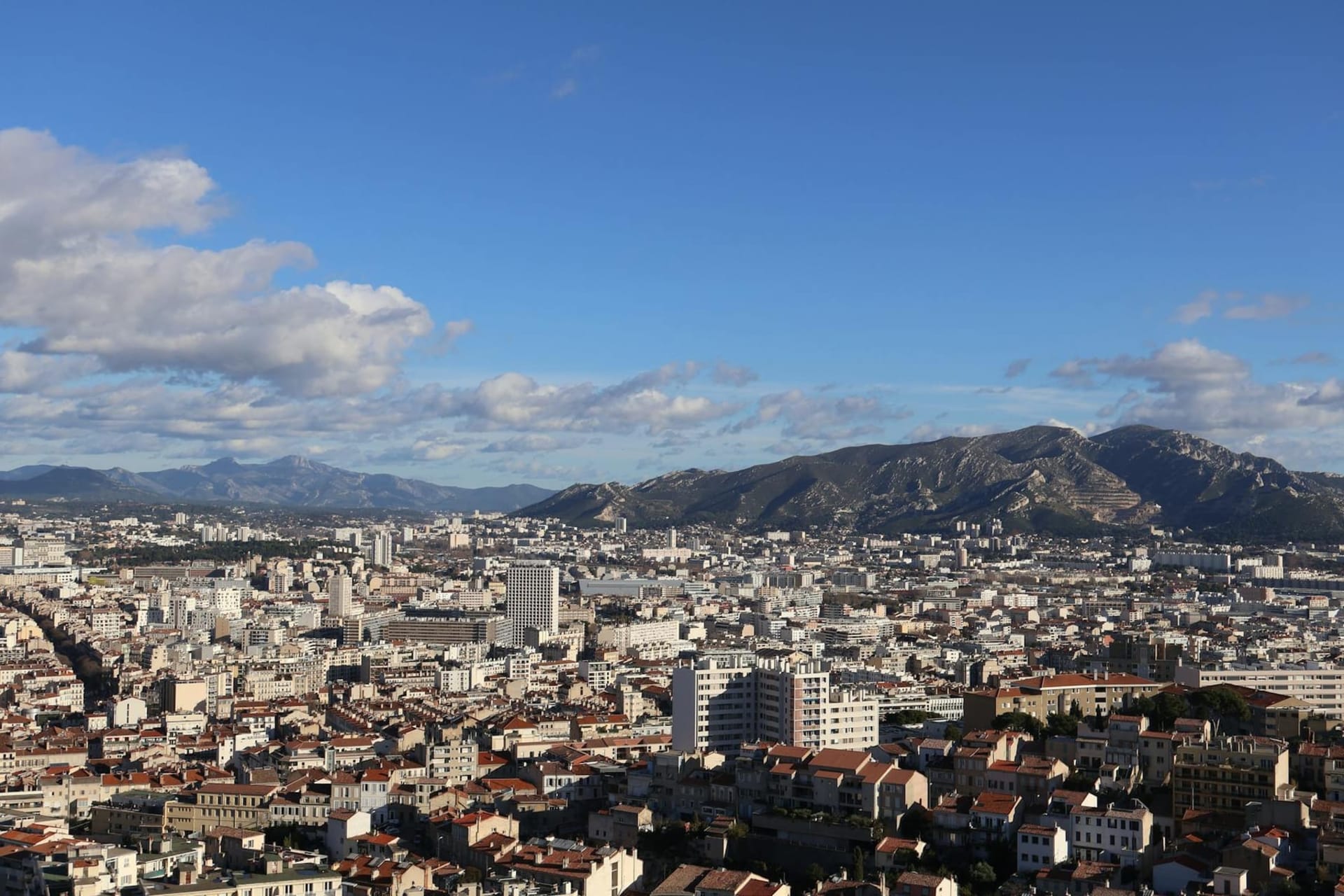
Marseille
"Marseille is the France that France sometimes forgets to claim, and all the better for it."
There is a particular shade of blue that belongs only to Marseille. Not the postcard blue of the Côte d’Azur to the east, not the polite blue of Parisian skies — this is something more abrasive, a Mediterranean light that bounces off the Vieux-Port at noon and makes your eyes water if you look at it too long. I stood at the end of Quai de Rive Neuve on our first morning, squinting, and understood immediately why painters have been coming here for centuries and leaving unnerved.
A Port That Has Always Been Someone Else’s Home
Marseille was founded by Greek sailors 2,600 years ago, and it has never quite stopped being a city of arrivals. Walking up through Le Panier — the oldest neighborhood in France, a tight maze of staircases and sun-faded facades above the port — I kept passing doorways where Arabic mixed with Comorian mixed with the particular slang-heavy French that belongs to this city alone. The walls were painted, not with commissioned murals but with something more provisional: tags and stencils and enormous pieces covering entire building sides, the accumulated record of whoever needed to say something.
We ate on Rue de la Paix, at a table barely wider than my forearm, a bowl of bouillabaisse that arrived in two services — the broth first, rust-colored and thick with saffron and fennel, then the fish piled separately on a platter. Rascasse, saint-pierre, grondin. The rouille came in a ceramic pot and tasted like garlic had been distilled into a paste and suspended in olive oil. Lia said nothing for a full five minutes, which I have learned to interpret as the highest possible praise.
The Surprise the Calanques Keep
I had expected the Calanques to be crowded — it was a Tuesday in late September and the trails down to Calanque de Morgiou were indeed busy. What I had not expected was the smell: wild rosemary and thyme crushed underfoot on hot limestone, so strong it almost read as artificial. The water in the inlet was a color I cannot accurately name. Turquoise undersells it. The stone walls of the calanque dropped straight into it, and I swam out to where the shadow of the cliff ended and the open sea began, and the temperature dropped ten degrees in a single stroke.
How the City Ends Its Days
By evening, the Vieux-Port fills with the specific energy of a city that has never tried to be elegant. The ferry to the Château d’If chugs back through the chop. Vendors sell sea urchins out of crates on the quay. The Basilique Notre-Dame de la Garde goes amber against the sky, visible from everywhere, the gold Madonna at the top catching the last light when everything below is already in shadow.
When to go: Late September through early November is ideal — the summer crush has thinned, the sea is still warm enough to swim, and the light has taken on a golden weight that justifies every superlative. July and August are brutal with heat and tourists in equal measure.