La Roque-Gageac
"There's barely room in La Roque-Gageac for a village at all, and somehow that's the whole point."
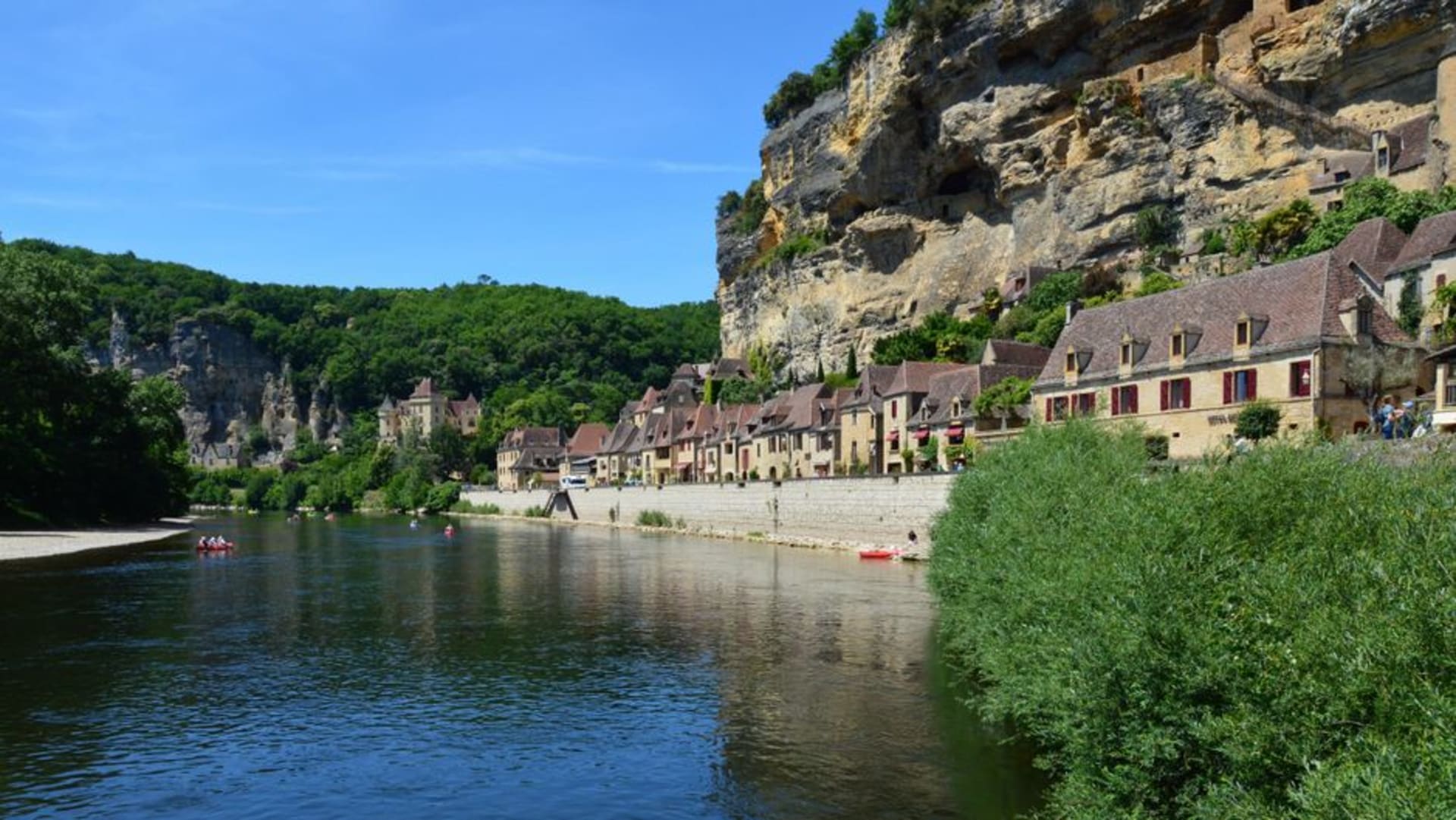
A single street of ochre houses pressed flat against a cliff on the Dordogne River, so narrow the village has nowhere to grow but up the rock face, and one of the most photographed river views in France.
La Roque-Gageac is almost absurdly narrow — a single main street squeezed between the Dordogne River and a towering cliff of golden rock, with houses that had nowhere else to go but up the cliff face itself, some of them built directly into caves cut into the stone. Lia and I arrived by car from Beynac along the river road, and the village appears suddenly around a bend, glowing ochre against the grey limestone, with banana trees and palms planted along the waterfront that look faintly absurd this far from any coast — a microclimate effect from the cliff trapping heat that lets exotic plants survive here.
Troglodyte houses and a fort you can’t easily reach
Partway up the cliff, cut directly into the rock, sits the Fort Troglodytique, a defensive shelter built into natural cave systems that villagers used for refuge during the Wars of Religion in the sixteenth century, accessed originally by rope ladders that could be pulled up to seal the whole thing off. We climbed the modern staircase up to it, and the view from the fort’s terrace back down over the village roofs and the river was worth the sweat — you can see exactly why this position was chosen, a sheer drop on all sides and a single controllable approach.
Higher still, above the fort, sits the ruin of a small château that belonged to the lords of Beynac and, on and off, was fought over during the same centuries-long Anglo-French standoff that shaped Beynac and Castelnaud downriver. There isn’t much left of it, but the climb up gives you the best angle on the whole valley, La Roque-Gageac’s rooftops directly below and the Dordogne curling away in both directions.
Canoes, and a village that only really has one street
Down at river level, we rented a canoe from an outfit at the edge of the village and paddled a slow loop, the current gentle enough for Lia, who had never canoed before, to manage without complaint. From the water the whole village reveals itself at once — there’s really only the one street, and everything else is just the cliff and the houses tucked into it, which makes La Roque-Gageac feel less like a town and more like an outcropping that happens to have people living in it.
We ate dinner at a small terrace restaurant right on the waterfront, watching the last canoes come in as the cliff face went orange, and agreed it might be the single prettiest spot in the entire valley — a genuinely difficult claim to make in a region this stacked with competition.
When to go: Late afternoon is the best time of day here regardless of season — the low sun hits the cliff face directly and turns the whole village gold. April to October for canoeing; the river’s too high and cold outside that window.