There are villages that refuse to be found, and Cucugnan is one of them. The D14 out of Duilhac cuts through garrigue so dense with rosemary and broom that the air thickens before the windmill even appears — a white sail turning slowly above the ridgeline, indifferent to whether you notice it or not.
We arrived on a Thursday in late October, Lia having spotted the village in a footnote about Cathar country rather than any proper guidebook. That is usually how we find the places worth keeping.
The Mill and the Sermon
The Moulin d’Omer stands above the village on a bare limestone spur, restored in the 1990s after more than a century of disuse. Inside, a recorded version of Alphonse Daudet’s Sermon de M. Martin plays on a loop — the curé of Cucugnan cataloguing his absent flock, village by village, in purgatory and hell. Daudet based it on a folk tale he heard in Provence and set it here, in this precise nowhere. The joke is that nobody from Cucugnan actually read it. The village has about ninety residents. Most of them have probably heard the recording more times than they can count.
The view from the mill terrace stops you from thinking about literature for a while. The Corbières opens southward in terraces of schist and limestone, vineyards the color of rusted iron in autumn, the distant outline of the Canigou floating above the haze on clear mornings. No marker, no viewpoint sign. Just the wind and the creaking mechanism.
Stone, Wine, and the Street That Goes Nowhere
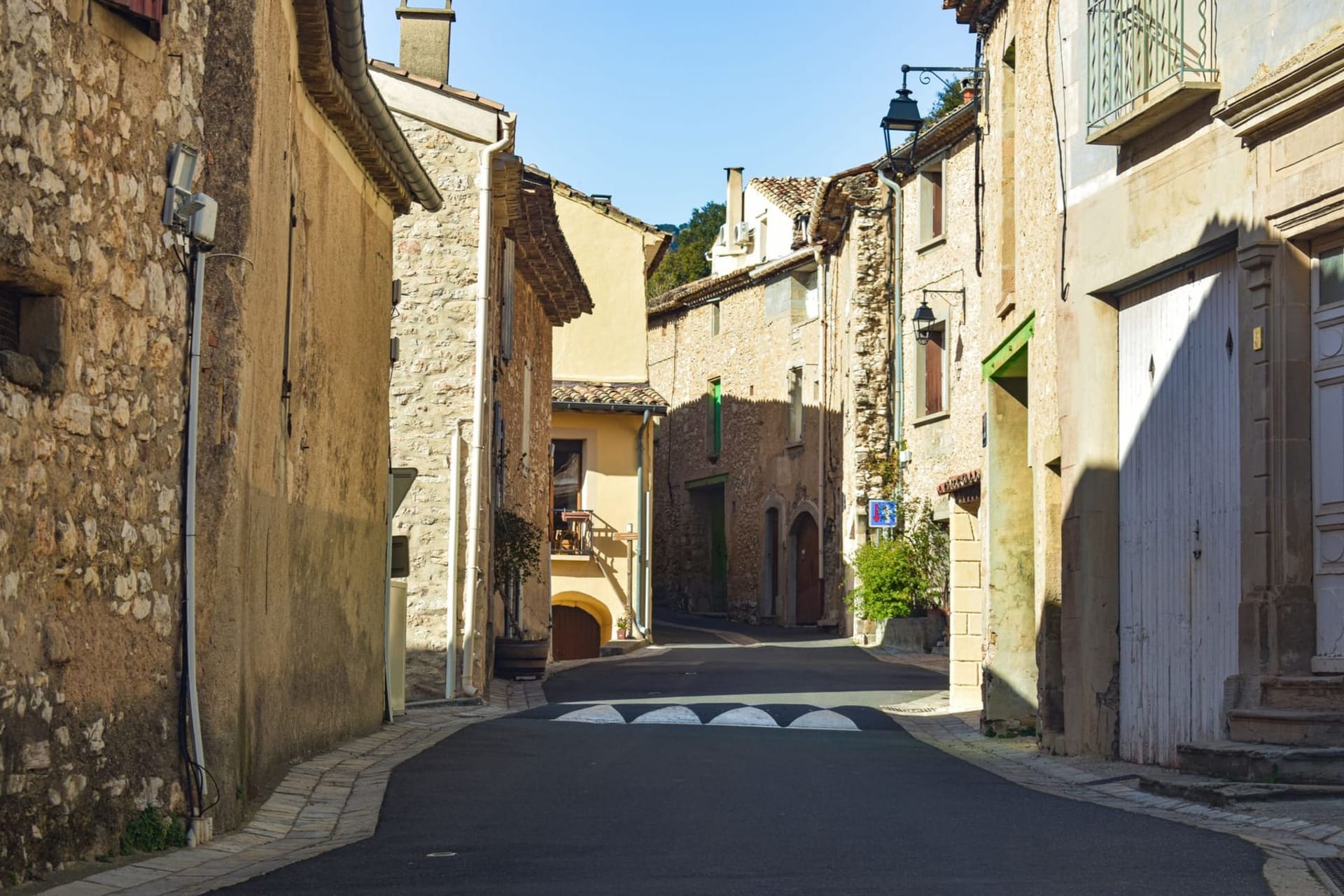
The village itself is a single loop — roughly the Rue de l’Église and a few unnamed lanes that dead-end against garden walls. The church of Saint-Julien-et-Sainte-Basilisse dates to the twelfth century and keeps irregular hours. We found it unlocked one morning, the interior cool and stripped bare, smelling of old stone and candle wax in proportions that felt exactly right.
The unexpected discovery came at the cooperative, the Cave de Cucugnan, just off the main road. I expected the usual tourist-facing setup. What I found instead was a counter staffed by a man who wanted to talk about terroir for forty-five minutes. He opened a Corbières-Boutenac without being asked, a 2019 with tannins like dry creek beds, and charged us less than I would have paid for a carafe in Carcassonne. Lia bought three bottles and carried them back to the car wrapped in her jacket.
That evening we ate cassoulet at the only café, at a table outside as the light left the windmill and the village settled into something between quiet and silence.
When to go: Late September through early November, when the vendange is finishing and the Corbières light turns amber and horizontal. Midsummer brings heat and tour buses from Quéribus — neither suits the village.