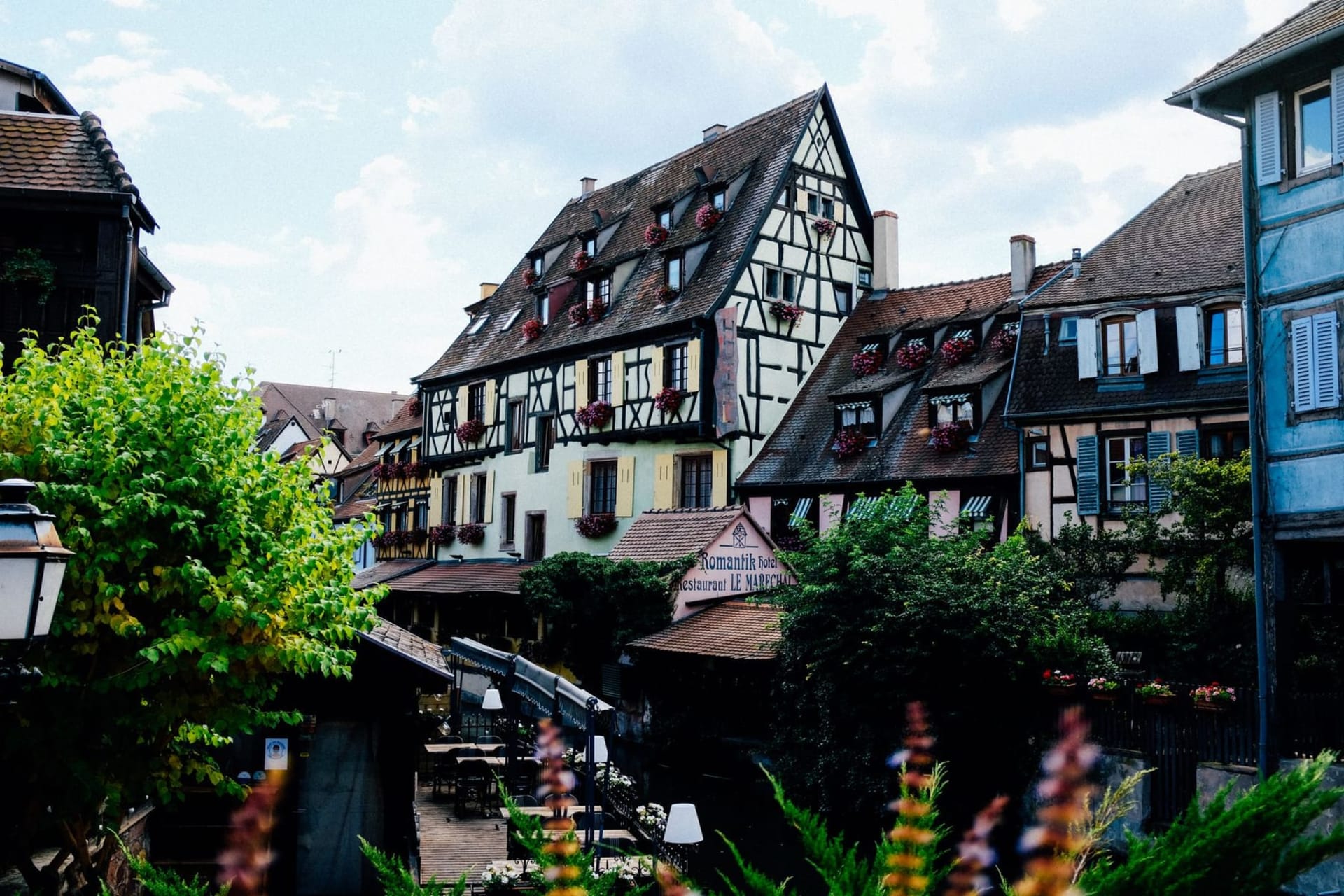
Colmar
"Colmar makes you question whether you've stumbled into an illustration rather than a real city."
I’ve stood in front of enough beautiful European townscapes to have grown slightly immune to them. Stone fountains, cobblestone squares, hanging flower baskets — the ingredients are familiar. Colmar did something I didn’t expect: it made me feel like I was looking at something impossible.
La Petite Venise at the wrong hour
We arrived on a Tuesday evening in late October, which turned out to be the right call. By eight o’clock the tour groups had dissolved back into their coaches, and the canal quarter — the Petite Venise, along the Lauch river — belonged almost entirely to us. Lia found a bench on the Rue des Écoles bridge and simply refused to leave it for twenty minutes. I didn’t argue. The water was the color of old glass, and the half-timbered facades on Quai de la Poissonnerie leaned toward each other overhead in shades of terracotta and pistachio that seemed physically incapable of existing in November light.
The smell of that first evening is what stays with me: woodsmoke from somewhere inland, and beneath it the faint sweetness of Gewurztraminer from a restaurant vent on Rue Turenne. Alsace smells like nowhere else in France.
What the old tanners’ district taught me
The surprise came the following morning in the Quartier des Tanneurs, the cluster of tall, narrow houses along the Rue des Tanneurs where leather workers once dried their hides on the upper balconies — hence the multiple overhanging wooden floors, stacked like shy stages. I had read about it, but reading didn’t prepare me for the scale of the silence there at nine in the morning, or for the fact that you can press your face against a ground-floor window of a building from the 1600s and see someone’s ordinary kitchen.
History here isn’t cordoned off. It’s just where people live.
We ate choucroute garnie that afternoon at a brasserie on Place de l’Ancienne Douane — the pork yielding, the sauerkraut bracingly sour, the glass of Pinot Gris slightly too cold and completely correct. The Ancienne Douane itself, the old customs house with its painted loggia, presides over the square with the easy authority of something that has outlasted every argument about whether it’s beautiful.
The Unterlinden and the thing I almost skipped
I had told myself I wouldn’t bother with the Musée Unterlinden. Then a librarian in Strasbourg told me I would regret missing the Isenheim Altarpiece. She was right. Matthias Grünewald’s altarpiece — a triptych of the crucifixion painted around 1515 — stopped me cold in a room full of other paintings. The suffering in it is not decorative. It felt, absurdly, like the most honest thing I’d seen all week.
When to go: Late September through early November for harvest season without peak crowds, or December for the Christmas markets, which are among the most atmospheric in Europe and worth the cold.