Bayeux
"I stood in front of seventy metres of embroidery and lost track of time completely."
A cathedral town that survived World War Two almost untouched and holds, in a single darkened room, a nearly thousand-year-old embroidered account of the Norman conquest of England.
Bayeux was the first town liberated after the D-Day landings, and it was spared the bombing that flattened so much of the rest of this coast, which means the old streets around the cathedral look much as they did when William the Conqueror himself supposedly attended its consecration in 1077. Lia and I came for the tapestry and stayed for the strange feeling of walking through a medieval town that had, by pure geographic luck, been left almost entirely intact.
The embroidery that isn’t actually a tapestry
The Bayeux Tapestry — technically an embroidery, wool thread stitched onto linen rather than woven — is nearly seventy metres long and tells the story of the Norman conquest of England in 1066, from Harold’s oath to William through to the Battle of Hastings, in a continuous strip of vivid, almost comic-strip-like scenes. It’s kept in a purpose-built museum in a single long, dim room, and you walk its full length with an audio guide narrating each panel — Halley’s Comet appears partway through, stitched in as an omen, which is the detail that stuck with me most. Nobody is entirely certain who commissioned it or where it was made, though most historians now credit Bishop Odo, William’s half-brother, and English embroiderers working shortly after the conquest. We went round twice, once for the story and once just for the border decoration, which is full of strange fables and, occasionally, something considerably ruder.
A cathedral, a river, and the road to the beaches
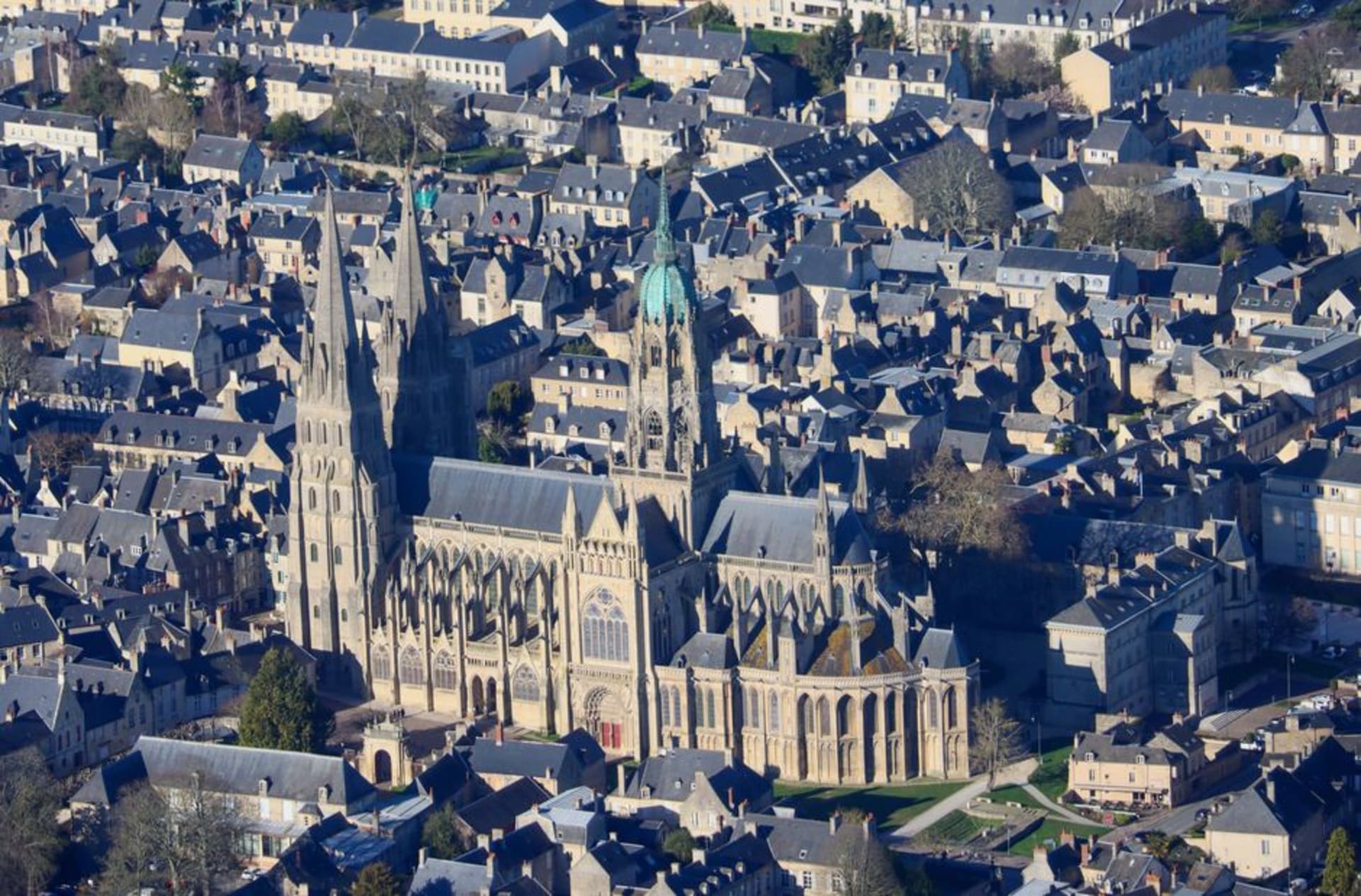
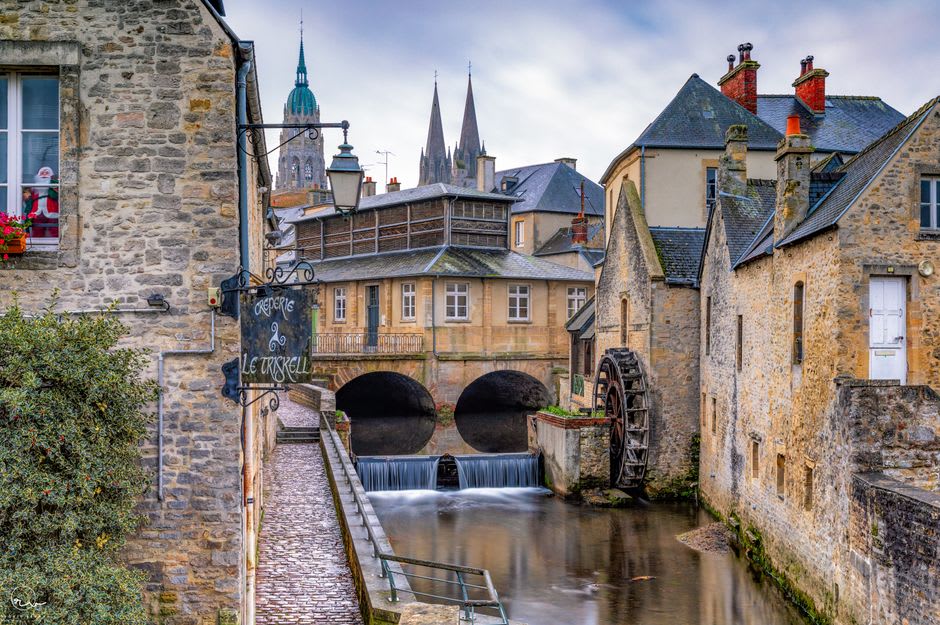
The Cathédrale Notre-Dame de Bayeux, the tapestry’s original home before it was moved to the museum, rises over the old town with two Romanesque towers and a soaring Gothic nave, and the Aure river runs in narrow channels right through the historic centre, past old watermills and stone footbridges. Bayeux also sits at the natural gateway to the D-Day landing beaches, a short drive from Omaha and Gold, and the town’s British War Cemetery, the largest Commonwealth cemetery from the Second World War in France, holds nearly four thousand graves in neat rows just outside the centre. We walked through it in the late afternoon, the light low and quiet, before heading back into town for dinner near the cathedral, its towers lit gold against the dark by the time we finished.
When to go: Book the tapestry museum entry ahead in summer, when queues build fast. Early June, around the D-Day commemorations, brings a moving but very crowded atmosphere to the whole region.