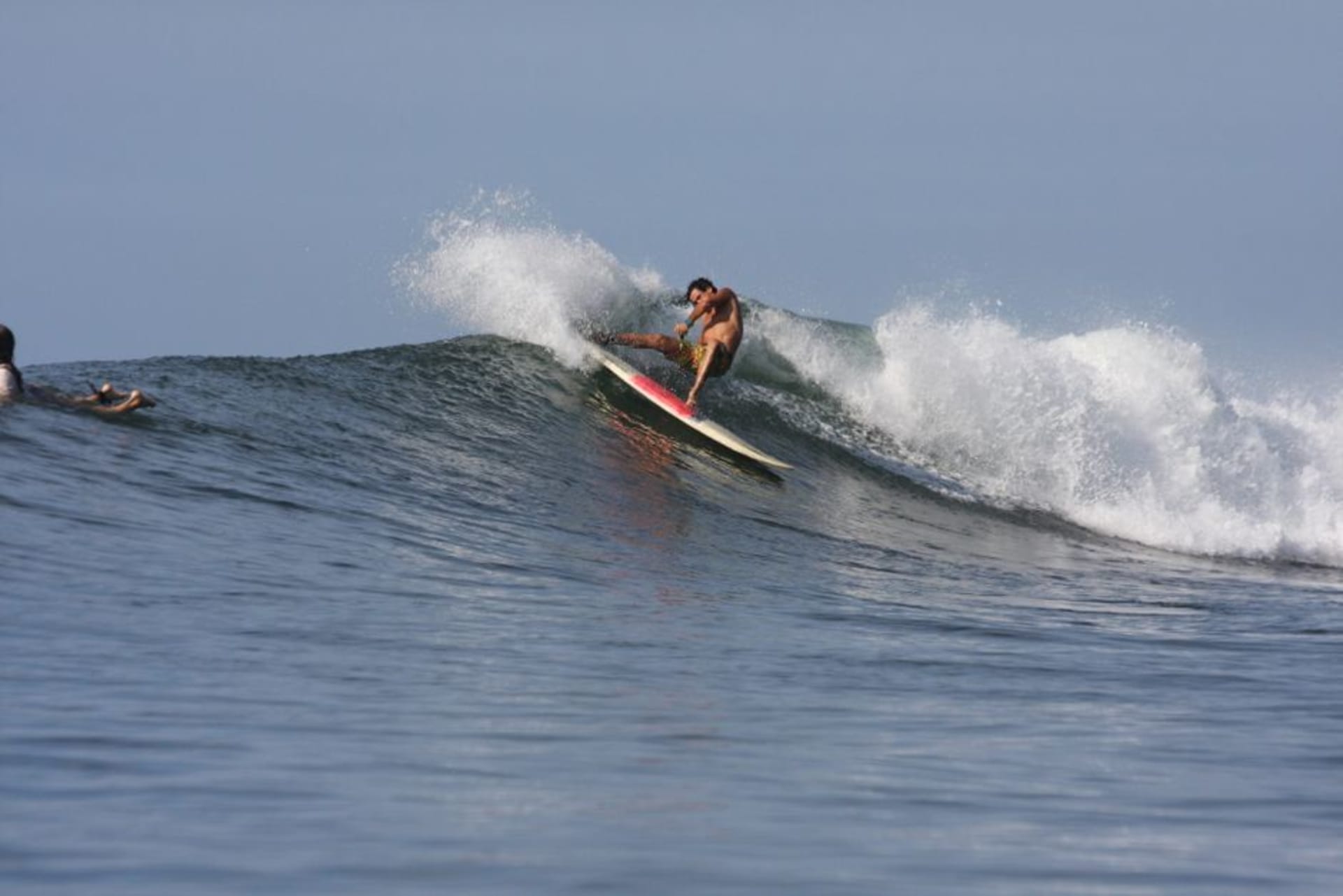
Playa Las Flores
"I counted eleven turns on one wave at Las Flores before my legs gave out first, not the wave."
An eastern right-point break with fewer footprints in the sand than El Tunco and a wave that peels for what feels like a full minute.
I got to Playa Las Flores by asking three different people for directions in three different towns, which should tell you something about how off the main circuit it still is. The road east from El Cuco narrows and the pavement gives up entirely for the last stretch, dust rising behind the truck I’d hitched a ride in, and then the trees open up and there’s the point — a long cobblestone arm reaching into the Pacific with a wave already breaking cleanly along its length, no one out.
That last part changed within the hour, but not dramatically. A handful of local surfers paddled out from a wooden rack of boards near a comedor, nodded at me, and got on with catching what might be the best right-hand point break in the country. Las Flores works on a rocky point that holds a swell and organizes it into a wave that just keeps going — section after section, the kind of ride where you start planning your next three turns before you’ve finished the first. Compared to El Tunco’s punchy left, this felt unhurried, almost generous.
A point break finding its feet
What struck me most was the infrastructure still catching up to the wave. There’s a surf camp with a handful of rooms, a couple of family-run comedores serving fish plucked from boats pulled up on the sand that morning, and not much else — no strip of bars, no crowd jockeying for priority. The surfers who do make the trip east tend to be the ones who’ve already done El Tunco and El Zonte and are looking for something with more room to breathe. I talked to a Salvadoran surfer from San Miguel who drives out most weekends specifically because he can get twenty waves to himself before lunch.

I paddled out in the afternoon when the wind had gone light and offshore, and caught a wave that ran so long I lost count of the sections — a drop, a wall, a little close-out threat that opened back up, another wall. I came in with my arms shaking and sat on the point watching pelicans work the water just past the break, dropping like punctuation marks into schools of baitfish. There’s a version of surf travel that’s about chasing the crowd to the good wave, and there’s this — chasing the good wave away from the crowd, at least for now.

That evening I ate a whole fried fish with my hands at a plastic table twenty feet from the water, the owner’s kids running past chasing a soccer ball, a radio somewhere playing bachata low enough not to compete with the waves. Las Flores isn’t quiet exactly — it has its own soundtrack — but it is unbothered, and that’s rarer on this coast than it used to be.
When to go: November through March for the most consistent groundswell and the driest, calmest weather; the point handles bigger swells better than most beach breaks nearby, so it’s worth checking even when other spots look blown out.