The fissure doesn’t announce itself. You walk out from the car park along a path through dry highland scrub, the Huíla Plateau flat and unremarkable around you, and then suddenly there is no more ground in front of you and the world drops a thousand metres and continues dropping until it becomes the horizon. The Tundavala Fissure — a rift in the escarpment about twelve kilometres from Lubango — is the kind of view that arrives without transition. One moment: scrub and dust and the sound of wind in dry grass. The next: the entire Namib basin laid out below you like a map someone unfolded carelessly.
I went in the morning, early enough that mist was still rising from the valley below, pooling in the gorges that cut through the lower escarpment. From the top, the mist looked like slow breathing. The drop from the lip to the coastal plain is given as approximately 1,000 metres, but measurements like that become meaningless when you’re standing at the edge. What you register is not a number but a sensation — the slight lightness in the knees, the instinct to step back, the awareness that the ground you are standing on is making a decision about whether to continue that it appears to have made for now, but which feels provisional.
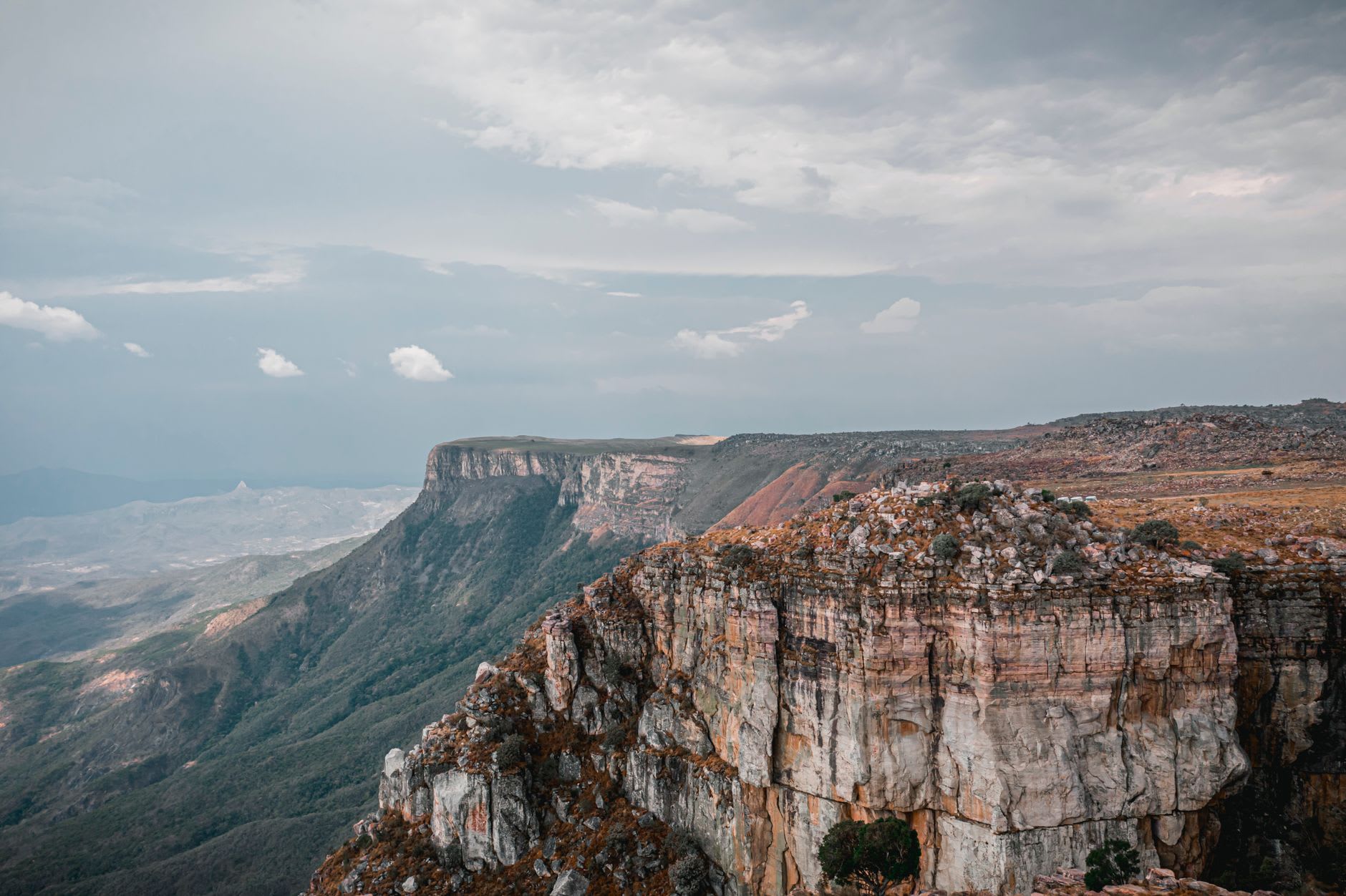
There are no guardrails at the best viewpoints. This is either a feature or a problem depending on your relationship with exposure, and I found it to be a feature — the absence of infrastructure forces a particular attentiveness. You choose your steps. You choose your distance from the edge. You exist at the lip of a cliff in a country that trusts you to manage your own vertigo, and something about that trust feels respectful rather than negligent.
The fissure extends for several kilometres along the escarpment edge, and you can walk sections of it in both directions from the main viewpoint. I walked north for about forty minutes, along a path that stayed well back from the edge except at two places where the path curved toward it and you could stand on flat rock with the void directly in front of you. At one of these points, a pair of black-and-white birds — I couldn’t identify them with any confidence — launched off the cliff edge and disappeared downward into the thermals, and I watched them shrink to specks in the space below the cliff and then become invisible against the pale plain.
The quality of light at Tundavala changes through the day in ways worth attending to. In the morning the escarpment catches direct light and the cliff face shows its colours — ochre, iron-red, pale grey — while the plain below is still in shadow. By midday everything washes out in the overhead sun. The late afternoon, when the shadow of the plateau begins to extend down the cliff face, gives the fissure a different drama — darker, more vertical, the distance below becoming less readable and therefore more alarming.

The drive from Lubango takes about thirty minutes on a decent road that winds through highland villages where children wave with the enthusiasm that suggests they don’t see many vehicles. The site itself has a small parking area and nothing else — no café, no ticket booth, no gift shop. You arrive, you walk to the edge, you stand at the limit of the continent, and then you drive back. It is the most complete visit I made in Angola. Everything essential was present and nothing unnecessary had been added.
When to go: Dry season, May through October, for clear views — the coastal haze is manageable and the cliff edge is free of the wet-season cloud that can completely obscure the view below. July and August mornings often produce the mist-in-the-valley effect that is worth seeing in itself. Arrive by 8am to catch the best light on the cliff face. The site is 12 km from Lubango and easily combined with Serra da Leba on the same day.